
Professor Martin Tomitsch on Designing for the Long View

It’s early morning in Central Europe when we connect, but already dinnertime in Sydney, where Martin Tomitsch dials in. Living in Australia for more than 15 years, he grew up on an organic farm in Austria’s Voralpen region, where his parents converted the land to organic production in the 1980s, long before it was mainstream. “It was like an organic startup,” he recalls. His stepfather taught electronics at a technical high school, and at home was always inventing and tinkering. Martin learned programming and electronics early, building systems and even small software applications to help run the farm. The rhythms of agriculture mixed with experimentation and invention shaped his early sense of systems — ecological and technological — working in tandem.
“My goal is passing on not just methods and technical skills, but an ethical framework and sense of responsibility.”
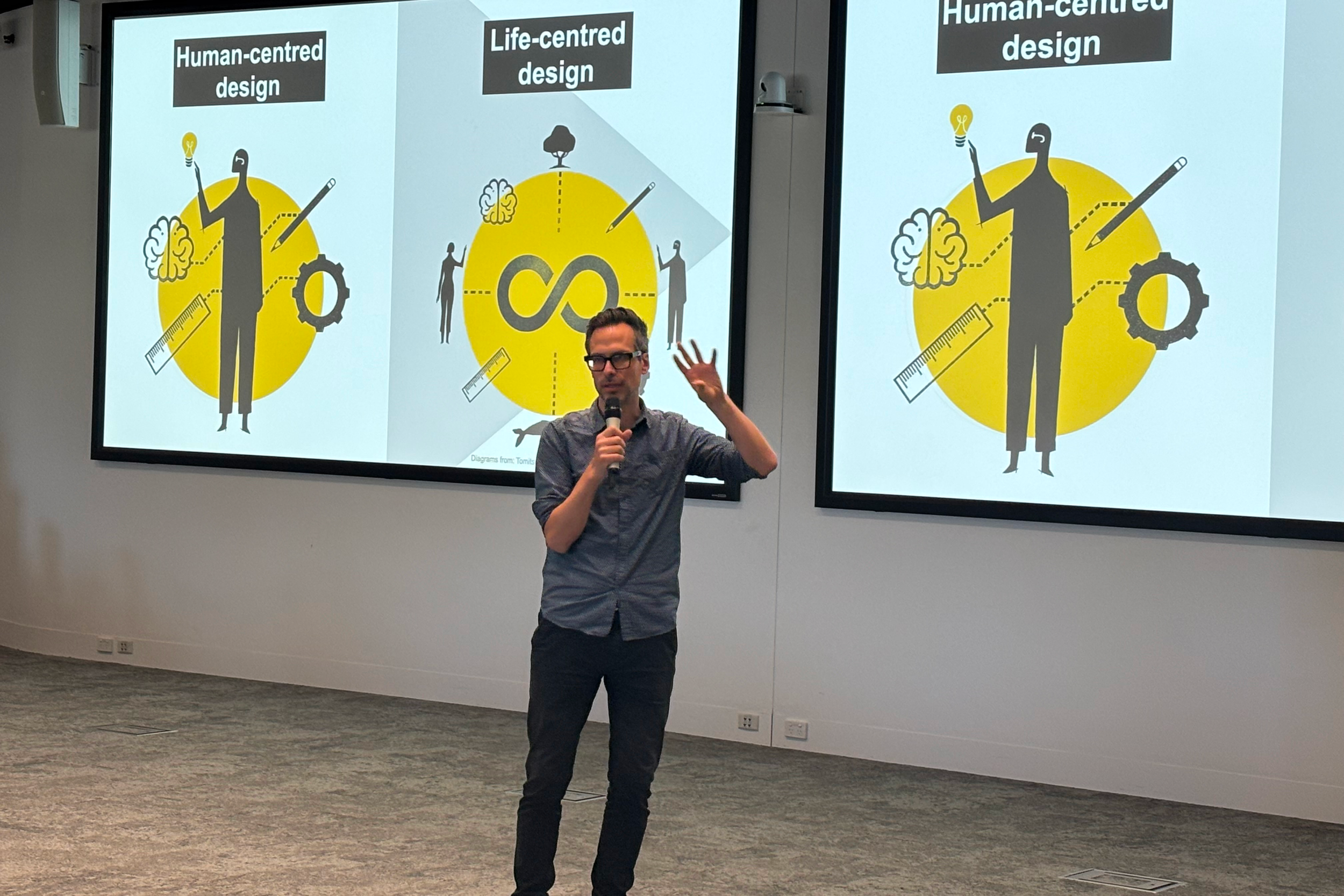
He first pursued informatics at the Vienna University of Technology, deliberately choosing it because it allowed him to take electives across disciplines — economics, business, architecture, graphic and product design. An exchange semester in Stockholm introduced him to human-computer interaction, which became the focus of his PhD. “I came more from a technical background originally and moved from there into the design field,” he says. Over time his focus shifted from human-centered to life-centered design, extending concern beyond immediate users to include non-humans, ecosystems, and future generations.
Today, Tomitsch is a Professor and Head of the Transdisciplinary School at the University of Technology Sydney. Sharing his knowledge and experience with students, he stresses, is his main channel of impact: “Passing on not just methods and technical skills, but an ethical framework and sense of responsibility.” Alongside more than a hundred academic publications, he has written accessible method books “for students and people in industry,” he explains.
“Earlier design education remained focused on artifacts and methods, without acknowledging the ripple effects design decisions can trigger in organizations, systems, and societies.”
One of his most visible efforts to open design to a wider public has been a massive open online course, funded by the New South Wales Department of Industry and deliberately designed for non-designers. Since launch it has reached more than 170,000 learners. He recalls a practitioner in Sydney who once said, you don’t have to be a designer to think like one. “That really resonated with me, and with our learners,” he says. The course carried forward the mantra coined with colleagues: think, make, break, repeat. “I often get emails from people saying they’re using this way of thinking in their work, and it’s really groundbreaking for them.”
Yet while democratizing methods is vital, Tomitsch insists designers must also move beyond objects and techniques to consider their broader impact. In his view, it is a shortcoming of earlier design education that the focus remained on artifacts and methods, without acknowledging the ripple effects design decisions can trigger in organizations, systems, and societies.
“Designers had a seat at the table, but not much actual power to change things.”
This systems perspective also shapes how he reads design’s role in organizations. In the early 2010s, companies experimented with “chief design officers” and “chief experience officers.” “That didn’t really work out,” he says. “Designers had a seat at the table, but not much actual power to change things.” Now he sees design shifting again — becoming more embedded and distributed, influencing from the backseat rather than the top.
The turbulence of recent years has tested these shifts. “A lot of things happened at the same time,” he reflects. “The impact of the pandemic, advances in AI, the global financial crisis, and the need for organizations to save money. Designers have always been the first ones to get cut if budgets shrink.” He adds that job growth has stagnated, even as more design graduates enter the market. Graduate programs and mentoring schemes have declined, leaving many companies only seeking experienced designers.
“Th nature of jobs is changing (...) Build distinctive capabilities — e.g. systems thinking, sustainability fluency, and skills that make you stand out.”
Even so, he sees opportunity. Referring to the World Economic Forum’s Future of Jobs report, Tomitsch notes that while traditional roles like graphic design are declining, UI/UX design was listed as the eighth fastest-growing job worldwide. “That gives me hope,” he says, “but it also means the nature of those jobs is changing.” His advice to students is clear: build distinctive capabilities — systems thinking, sustainability fluency, and skills that make you stand out.
In Australia, new regulations now require large companies to report on sustainability performance. Tomitsch explains the categories in simple terms: direct product emissions; energy and resources like electricity or water; and, hardest of all, the supply-chain emissions that often dominate. He cites supermarkets grappling with the footprint of meat production. One experiment placed plant-based alternatives directly on the meat shelf — sparking public debate, but also showing how design can make systemic shifts tangible in everyday life.
Still, many organizations are focused on speed, cost, and AI adoption rather than sustainability. Tomitsch argues these need not be in conflict: “You can replace the word sustainability with AI or cost optimization, and the design approach still applies. It’s about showing how design methods can benefit the business while also addressing broader goals.”
“Start small. Rather than aiming to change everything at once, focus on the 1% shifts that compound over time. Those small changes add up.”
His recent book Designing Tomorrow advances this mindset through what he calls “cathedral thinking” — an ethic of intergenerational design. The principle, he explains, is to start small. Rather than aiming to change everything at once, focus on the 1% shifts that compound over time. “Those small changes,” he emphasizes, “add up.”
For Tomitsch, cathedral thinking is inseparable from networks. He cites the “seventh generation principle” — thinking back three generations, acting in the present, and looking forward to three more. He often repeats a phrase from the university sector: “go slow to go fast.” For him, investing in networks and relationships upfront means that when change is needed, organizations can move quickly because buy-in already exists.
“Think about where you want to be, work backwards, figure out the networks you need to build, the skills you need to learn, and how to position yourself.”
As our conversation winds down, he reflects on design not just as a practice, but as a way of navigating life. He tells students to use design methods on their own futures: “Think about where you want to be, work backwards, figure out the networks you need to build, the skills you need to learn, and how to position yourself.”
That mindset returns him, in a way, to the Voralpen farm of his childhood — a place where invention, experimentation, and systems of growth shaped his first understanding of how things come to life. From organic soil to digital systems, from prototypes on a farm to cathedral thinking in organizations, Tomitsch’s work is still guided by the same principle: design is about cultivating long-term change.

Professor Martin Tomitsch is Head of the Transdisciplinary School at the University of Technology Sydney, a founding member of the Media Architecture Institute, the Urban Interfaces Lab, and the Life-centred Design Collective. His books include Making Cities Smarter, Design Think Make Break Repeat, and Designing Tomorrow.
