
Ciarán Duffy on Power in the Margins
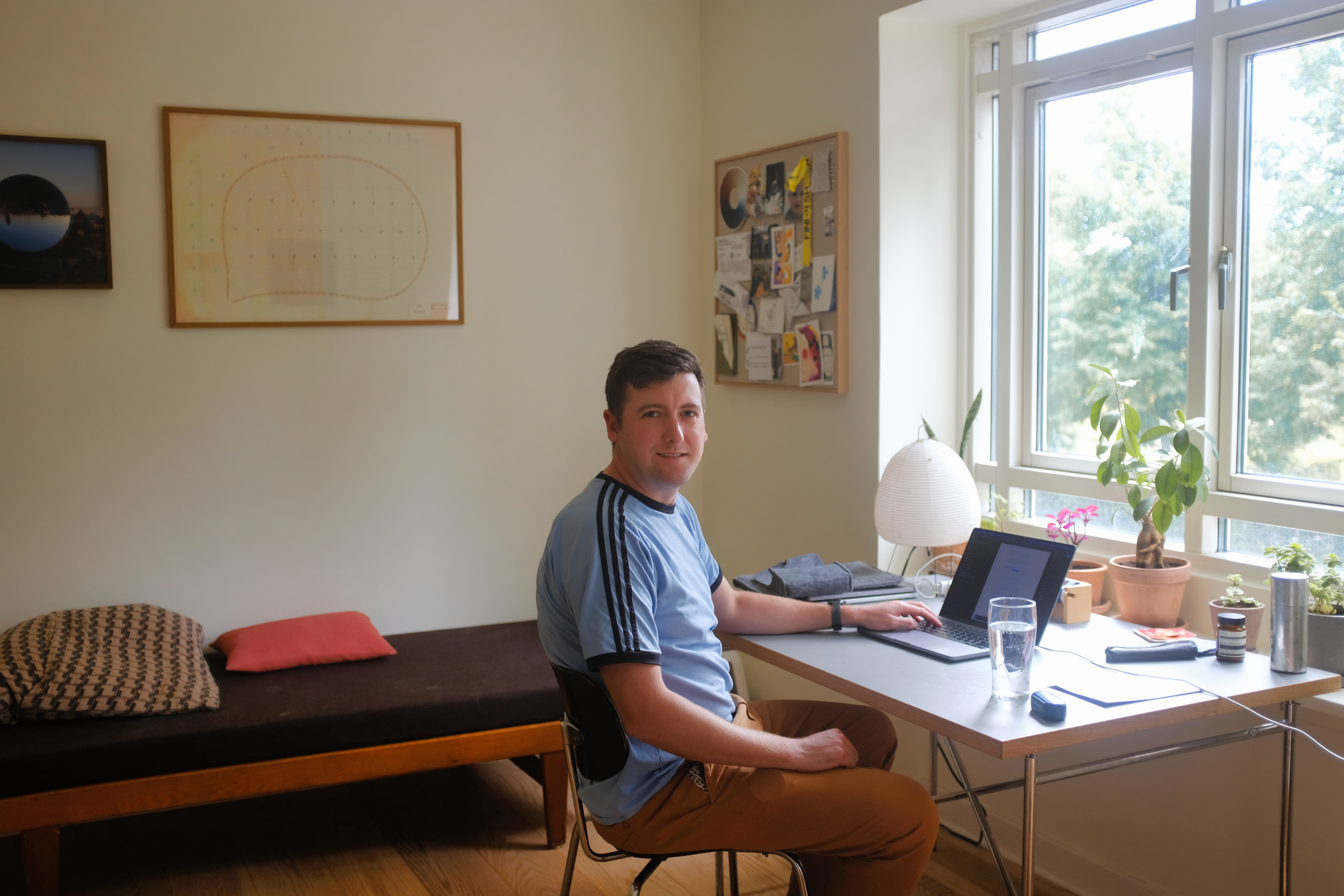
When we meet Ciarán online, he is calling in from his studio in Berlin’s Neukölln district. His path into design began informally, teaching himself to build websites before he even knew design could be a career. Later, postgraduate studies in interaction design brought structure, and early work in an innovation agency gave him exposure to fast-moving projects. But what has defined his trajectory since is a move away from polished surfaces and toward humanitarian and healthcare contexts, where design is about managing the intricate systems that shape people’s daily lives.
“I think our role is to tame complexity, not to shy away from it.”
“Object-Oriented UX (OOUX) has been this magic sauce,” he says. “It’s helped me manage complexity and tame complexity. And we as designers, I think our role is to tame complexity, not to shy away from it. Healthcare in particular will always be exceedingly complex, but we need to have something to tame it.”
Today, he is helping build a data and insights platform to show what gets in the way of good health across various segments of a population. Design here is less about sleek interfaces than about patterns in data that would otherwise remain invisible. For Ciarán, the OOUX mindset begins with understanding how people bring expectations from the physical world into digital ones.
“The chair is always the chair, whether it’s outside the coffee shop or inside,” he explains. “But when the space becomes digital it’s so easy for those objects to shapeshift. He illustrates with Netflix. “If you go into Netflix you’ll have TV shows and movies, and they need to look different because they are different. With a TV show there’s going to be episodes, series, and so on. With a movie it’s a one-off thing. If you were in the Netflix engineering room they might be calling everything audio-visual content. But the designer’s job is to be like: what does a user call it? They call it a movie, they call it a TV show. Let’s make sure that’s how it looks for a user.”
“AI research tools don’t replace expertise, but help break down assumptions, validate ideas, and keep design connected with perspectives that might otherwise be missing. ”
AI has, as Ciarán puts it, “turbocharged almost every part of the process.” One of the most striking uses for him has been getting AI to simulate perspectives he cannot easily access: “a midwife in a resource-challenged hospital, a program manager at a Ministry of Health, an IT technician organizing the medical record system,” he lists. “Their time is precious, maybe you get them on the phone once every six months. But you can ask AI that question conversationally, and get an answer immediately.”
For him, this doesn’t replace expertise, but it helps break down assumptions, validate ideas, and keep design connected to perspectives that might otherwise be missing. At the same time, AI is making it trivial to generate visuals or fill interfaces with plausible copy. That development has changed who needs to be in the room.
“Upwork and these prompt-to-visual tools have really destroyed that bottom half of the totem pole,” he says. “Anybody, whether they’re a designer or not, can make something that looks decent. But you really need a designer to take it that last mile — to take away what isn’t working, to make it a little bit more intuitive. That bottom-of-the-totem-pole type of work is maybe gone because of AI, but at the very height of it you need somebody to refine what AI creates, to take it the last mile.”
For Ciarán, the “last mile” is now the designer’s territory. It’s where nuance, intuition, and craft separate professional practice from automated output. The shift mirrors a larger truth running through the profession: the entry-level work that once trained juniors is being eroded, while expectations at the top only increase.
“Anybody, whether they’re a designer or not, can make something that looks decent. But you really need a designer to take it that last mile.”
This is also why he pushes back on the romantic idea that designers should approach everything with naïveté. “That whole idea of approaching a project with a beginner’s mindset is rubbish,” he says. “It shoots designers in the foot, because they can’t have a conversation at eye level with somebody who is an expert in their domain.”
Instead, he argues for clarity about expertise. “We need to recognize what we are experts in, and then build up enough domain knowledge to ask questions at eye level with people who have decades of experience. It’s not that we need to be doctors or marine biologists, but we can’t be going into those situations as beginners. In my work there’s a lot of time spent clarifying what design isn’t, clarifying what we do differently, and why it will be better than not doing it.”
That work of explanation is especially necessary in humanitarian organizations and global health, where design still feels relatively new. Often he finds himself the only designer in a room full of program managers, engineers, and strategists. “You need to be able to say, okay, if you’re going to invest in this one hire, here’s what’s going to be different. And here’s why it’s going to make your organization more successful in delivering whatever program it might be.”
When pressed on what exactly designers bring to the table, Ciarán’s answer is pragmatic. “Designers, like other parts of any organization, need to have some business acumen to understand how to advise, how to be strategic. What gets money through the door? What keeps the lights on? And then there’s communication — being able to explain to somebody why your proposal makes sense, why we’re not going to do something. That’s huge.”
“A strategy is only a strategy if doing the opposite sounds ridiculous.”
His own discomfort with the word “strategy” led him to look for more concrete answers. “Strategy really bugged me for a long time,” he admits. “You meet strategists who just seem like people who’ve been around a long time and give advice, but there isn’t often a process. So I went down a rabbit hole and did the design MBA to figure out: how do you actually design a strategy? I think I’ve got a critical mind, but I didn’t know how to do it.”
What he came away with was a sharper definition. “A strategy is only a strategy if doing the opposite sounds ridiculous. Saying ‘we want to grow by 10%’ — that’s not a strategy. But saying, for example, we’re not going to have receptionists in our hotel, we’re going to have self check-in, and then invest that money in the beds or the location — that’s strategy. At the beginning it sounds a bit crazy, but it’s literally the model of many successful hotels now.”
For Ciarán, designers can make such strategic choices tangible by prototyping them. “We can prototype the strategy. We can create little experiments so an organization can taste it, get a feel for it, get some metrics. That de-risks the whole thing before we play on. That’s, I think, part of what a designer in a strategic space should bring — allowing organizations to prototype a strategy.”
“I wouldn’t throw the double diamond out just yet.”
He is aware of arguments that cheaper AI-supported development might make discovery and prototyping less important, but he doesn’t buy it. “I wouldn’t throw the double diamond out just yet,” he says. “It depends on what you’re trying to de-risk and the size of the problem you’re starting with. If it’s just testing a feature, sure, build it and test it in code. But if it’s something really exploratory, early on, then research and discovery still need to happen. One of the strongest parts of design has always been getting the problem statement right.”
The question of who gets to do that work — and how new designers find their place in it — is one he takes seriously. “It is becoming harder for emerging designers to enter design-mature organizations,” he says. “Many of the best designers I’ve worked with are self-taught. That tells me design education needs to reflect on what the market is asking for. Off the top of my head, it’s business acumen and communication skills. That’s what’s missing.”
His advice is pragmatic, especially for graduates facing a job market that struggles to absorb juniors. “Try to find a way to build up business sensibilities. Startups can be good, because you won’t just be pumping out wireframes — you’ll be in meetings about funding, you’ll see why some things get designed beautifully and others just use off-the-shelf solutions. You’ll see how money and decisions shape design. And that’s valuable.”
Here again, Ciarán’s perspective points to a wider truth: the field is shifting upwards, with less room for entry-level roles and more emphasis on hybrid skills at the intersection of design, business, and communication.
“Ten years ago it felt like everything was going to be design-driven. Now, at least in the organizations I’ve worked with, it’s more about sprinkling design in, and that has to transform the outcome.”
Looking ahead, Ciarán doesn’t assume design will always sit at the center of decision-making. But he sees power in the margins. “Ten years ago it felt like everything was going to be design-driven. Now, at least in the organizations I’ve worked with, it’s more about sprinkling design in, and that has to transform the outcome. We can’t expect to always be driving the entire initiative from the ground up. But if we can bring exponential value even when it’s just sprinkled in — that’s where we make a difference.”
Perhaps this is the pivot the field needs. Not design as the loudest voice in the room, but design as a practice that sharpens, clarifies, and amplifies what others are already building. Power in the margins, not as loss, but as a different kind of influence.

Ciarán is a freelance designer from Ireland working with mission-driven organisations around the world to turn ambitious ideas into intuitive digital products. Since 2018, he’s been a member of Sonder Design Collective, contributing to projects like OpenMRS, an open-source medical record system used in 8,000 clinics globally, and TalkToLoop, a feedback platform for communities in crisis. In his spare time Ciarán is a long-struggling jazz pianist and avid record collector.
