
Felix Scharfenberg on Designing Through Disruption
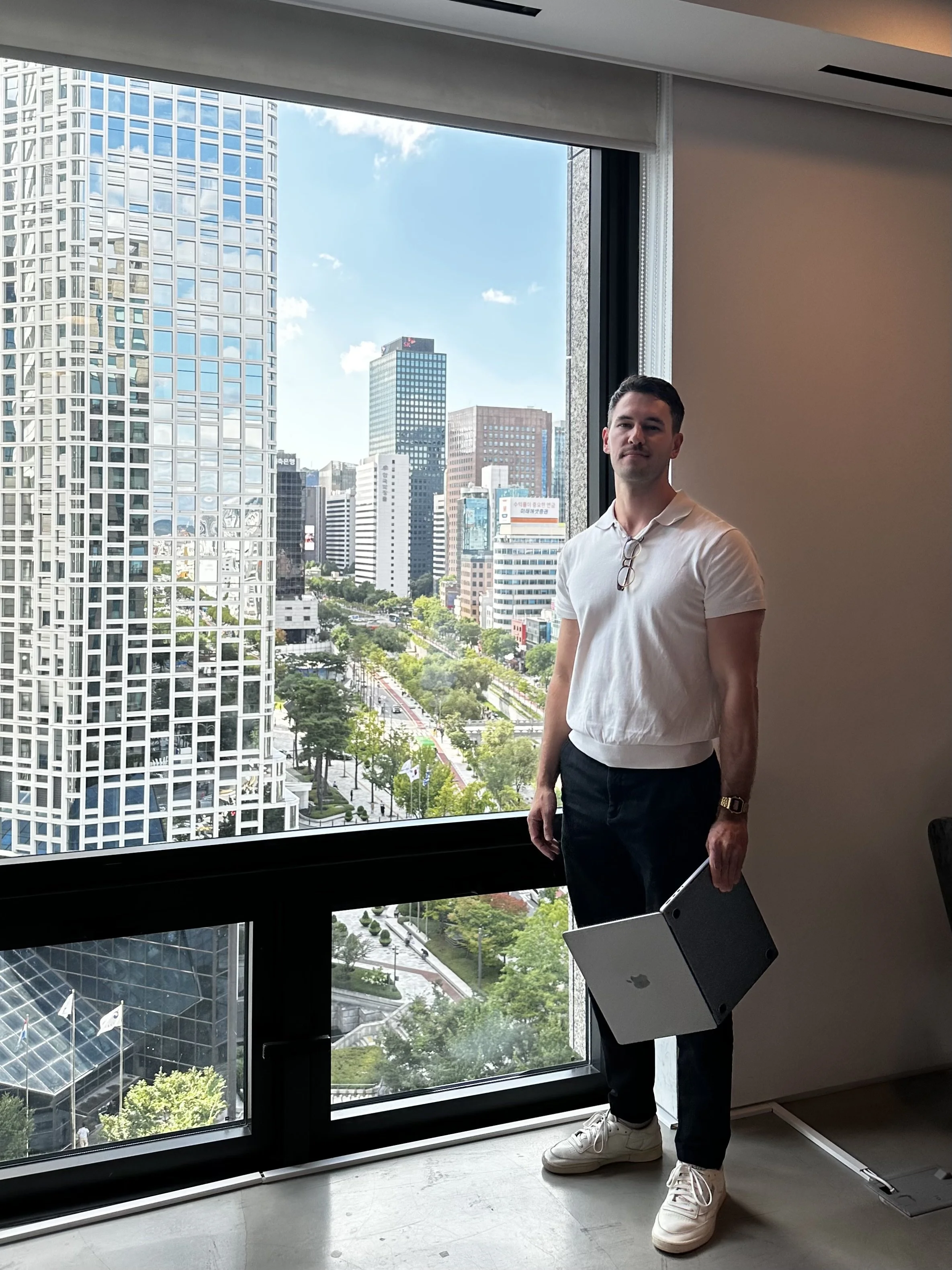
When we meet Felix online, he’s calling in from a remote island, where he’s taking a brief break after wrapping up a project in Singapore. Framed by the vibrant blue glow of his video background, Felix is typically based in major tech and innovation hubs like Singapore and Seoul. As an innovation consultant, he thrives in the fast-paced environments of these global cities, driving projects in Asia and the wider world.
“At the center is (currently) cost reduction, and of course efficiency gains.”
Felix pauses before describing his role. He resists a single label, sketching a mix of strategist, designer, entrepreneur, and project lead. His work spans strategy, research, prototyping, even bits of development to build proofs of concept. “At the moment, I would call myself more like an innovation strategist,” he says, “but I also like to be hands-on in the nitty gritty — research, prototypes, testing with users.”
His work is shaped by turbulence. Economic instability, shrinking budgets, and the rise of AI are redefining how consultants operate and what clients expect. Asked what forces matter most, he doesn’t hesitate: AI and macroeconomics. He points to geopolitical instability, supply chain disruptions, inflation, and interest rate hikes — all of which have shifted companies toward short-term improvements. “At the center is cost reduction,” Felix says. “Efficiency gains.”
“Of course we know as innovation consultants that this is actually the time where the big disruptions happen right now. And this is where you should invest, you need to change, right?”
That mindset is a dilemma. “Of course we know as innovation consultants that this is actually the time where the big disruptions happen right now. And this is where you should invest, you need to change, right? But a lot of the incumbents really have difficulty adjusting to this and they actually double down on just cost savings.” For consultants, that means smaller budgets, fewer long discovery projects, and pressure for “fast and tangible results.”
He recalls a project with a shipping client in Indonesia just before the pandemic, when he visited ports, spoke with truck drivers, and even rode along to observe how goods were processed — everything still manual. That kind of immersive research, he notes, has become rare. “Now we see more virtual work,” Felix says. “Smaller pilots, dipping toes rather than big investments.”
“AI has become a double-edged force”
AI, he says, has become a double-edged force. On one side, clients might expect advisories to deliver the same work in a fraction of the time — and at a fraction of the price. “Sometimes a third of the value,” he admits. On the other, it finally enables a form of agility that was once more rhetoric than reality. With fewer people and lower transaction costs, “even as a one-man show you can do quite a lot, and achieve tangible results fast.”
This shift, he argues, demands rethinking consultancy itself. For him, the disruption extends beyond clients to the consulting model itself. Traditional firms cling to old approaches, but he sees the need to diversify, launch his own projects, and experiment with AI-enabled agility. “If we can make it truly agile,” Felix says, “we might even disrupt the consulting industry.”
“It’s hard to show value in a static mock-up. You will need Wizard-of-Oz style demos, functional experiments, even if they’re rough, to show how (the idea) actually works. ”
Looking forward, he stresses two areas of competence. First, interpersonal skills: “If you cannot get the buy-in and make the client understand the benefits of some AI solution — and also make people actually use it, adoption is the big topic — you’re not going to make it.” Second, technical fluency: “Designers need to extend their ability to prototype something functional. With AI it’s hard to show value in a static mock-up. You need Wizard-of-Oz style demos, functional experiments, even if they’re rough, to show how it actually works. That will be required in the future.”
For Felix, old leadership models no longer apply. Measuring authority by headcount, he argues, is a liability: high transaction costs, minimal returns. “A small team with a few AIs in the background will be far more powerful.” He is equally dismissive of visual polish for its own sake. “I always saw designers posting extremely flashy designs that maybe look great but don’t function well. That’s not a differentiating factor anymore — especially in the time of AI, because AI can generate good-looking designs too. The differentiator is building the right thing, knowing what the customer actually wants.”
For Felix, even the label “designer” is up for debate. “A couple of years ago design was kind of ascending to the C-suite,” he says, citing Jony Ive and Airbnb’s founders. “But I feel like this is reversing. Design doesn’t have the same power in business anymore. That doesn’t mean the methods go away — the opposite, actually. User-centricity is more critical than ever, especially in AI. But we may need to insert ourselves more into the business context. In Asia, for example, design is often equated with aesthetics, or dismissed as corporate fluff. So it’s on us to reinvent what design means.”
“We know this stuff. So use that power and just do your own thing.”
His advice to younger practitioners is blunt: start doing. He points to the indie builder community, where the mantra is simple: you can just do things. For Felix, that is the advice he gives younger designers. “We know this stuff,” he says. “So yeah, use that power and just do your own thing.”

Felix is an innovation strategist and design leader with over a decade of experience at the intersection of design, technology, and strategy, helping Fortune 500 companies across Europe and Asia-Pacific turn emerging technologies into customer-centric solutions. Combining big-picture strategy with hands-on prototyping, Felix explores how AI can accelerate transformation, reimagine industries, and empower teams to validate bold ideas at speed.
