
Ana Viegas on Letting Go of the Title
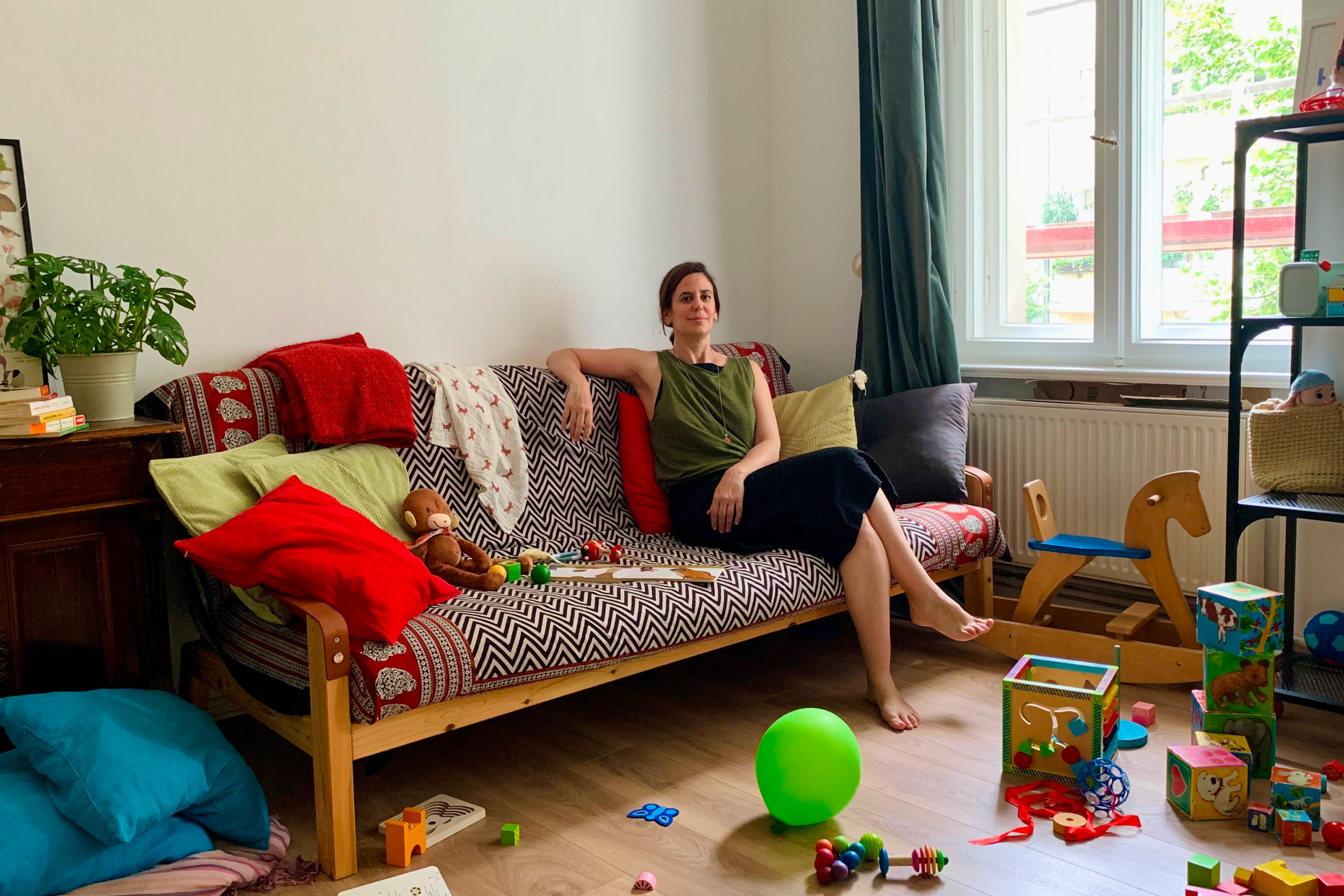
When we meet Ana Viegas online, she is calling in from her current “habitat” — the children’s room at home, surrounded by colorful toys and books of all kinds. It is here, in this space of play and learning, that most of her thinking now happens.
When Ana Viegas describes her former job, she doesn’t start with a title. “I guess I’d fall into what you’d call a generalist, or a generalist design practitioner,” she says. Her education was in graphic design and typography, but over two decades her practice stretched across digital, service, business, and strategic design. Most recently, she worked inside a bank’s strategy team, guiding internal groups through four pillars—viability, feasibility, desirability, and strategic fit—to assess whether ideas could become viable products or services.
Her official title was Solution Manager, though she confesses it never really fit. “Solution Manager doesn’t really tell you much. My role was to guide teams to understand the problem better and consider it from different perspectives in order for them to design better things.”
At the end of last year, she stepped away from that role, shortly after the birth of her child. That departure has become its own kind of discovery phase. “I left my job as I went into motherhood and during my maternity leave I decided that perhaps I wanted to do something else. Right now I’m figuring out what’s next — actually, that’s my practice.”
“At some point I started asking, what context do we actually operate in? Not just the company or the stakeholders, but the political systems, the social ecology, the environment itself.”
The shift from graphic designer to strategist was, for her, a natural evolution. She frames it through systems. Early on she worked with typographic and digital systems; later her focus widened toward larger contexts. “At some point I started asking, what context do we actually operate in? Not just the company or the stakeholders, but the political systems, the social ecology, the environment itself. As I evolved through my design practice into looking at these more complex systems, my role shifted toward asking how I could use my skills to guide the creation of products and services toward things that I believe are actually better out in the world.”
If the field itself is in transition, Viegas resists the word crisis. “Things are definitely changing. Only a blind person would say it’s business as usual. But it’s also too strong a word to call it a crisis. It reminds me of when digital was overcoming print, and as designers we are asking ourselves if we should learn to code. That was a silly question. I believe you should always understand the medium you work in. It doesn't mean that at that time we needed to become developers, just like it doesn't mean that we now need to become AI experts. It just means that we need to learn enough about the environment we operate in to understand where we can contribute and create an impact. The world around us is evolving, and design practice needs to evolve with it.”
“Yes, AI can speed up your practice. But is that acceleration actually a good thing? That’s what we need to question.”
For her, there are a multitude of reactions to this transitional moment, she explains three that stand out: “There are those who go all in, who see AI as a savior. Then there are those who are totally afraid, especially if they’ve never known anything beyond the digital world we have now. And then there are those of us who are questioning what it really means. AI is not evil, it’s not going to doom us all, but it will require a significant shift in how we see the practice and our roles in it. Acceleration alone”, she adds, is not the point. “Yes, AI can speed up your practice. But is that acceleration actually a good thing? That’s what we need to question.”
Her reflections often return to education—what helped her, what didn’t. Much of her learning was self-directed. “While studying, I taught myself to code basic websites so I could freelance. I’m not a software developer, but I know enough to work better in product teams. That kind of inherent curiosity is what helped me. A lot of it is self-taught, and a lot of it comes from learning from mistakes and from colleagues who taught me better.”
That’s why she is skeptical of quick credentials. “My suggestion is: don’t just rely on some kind of title from a university or academy. Go out there and learn from your practice. Learn from better people. Associate yourself with people who are questioning how you do things and how you can adapt.”
“The problem with design thinking was that we thought we could go into companies and solve all their problems. And that’s just not the case.”
This questioning extends to design’s role in business. “The problem with design thinking was that we thought we could go into companies and solve all their problems. And that’s just not the case. We often lack contextual knowledge—supply chains, risk analysis, operations—that don’t necessarily get outweighed by the argument of delivering total customer centricity."
As companies absorbed design methods, ownership blurred. “Suddenly you had strategists using design thinking, engineers becoming product owners using design systems, even though these were our core skills. Other departments were doing it too. To a certain extent, we lost ownership of what we brought to the table. What remains distinctive is that we’re often the critical voice at the table. Not the negative voice, but the one that asks: yes, we can do this, but should we?”
For Viegas, this critical stance matters more than any job description. “Do you need to identify yourself as a designer? Is design a skill you have, or is it your identity? I’ve not been called a designer for years, even though that’s what I see myself as. Every time I try to explain it, people don’t really know what I mean. So I’ve let go of the name itself and instead prefer to describe what I do.”
“Less emphasis should be put on the title, and more on: you’ve learned a set of skills, how can you use them to put yourself in the position you want?”
She imagines the profession moving further in that direction: skills rather than labels. “Less emphasis should be put on the title, and more on: you’ve learned a set of skills, how can you use them to put yourself in the position you want? Maybe that’s as a strategist, maybe as a business person. The important thing is adaptability.”
Letting go doesn’t mean dilution. “It’s not that other departments can do 100% of what we do, or that AI will replace us. There’s still expertise behind design that can’t be easily replicated. For me, it’s about how to design the infrastructure to come to better solutions.”
Her own education offered a model. During her masters, her tutor once showed her five books seemingly unrelated to her project, pushing her to expand her perspective. “It just broadened my perception so much that I could look at it from totally different angles and grow with it. That was one of the most important things I learned — critical thinking, looking at things from other perspectives, and using that to design new ways of working.”
“I’d really like to see design evolve away from the designer hero who does nice pretty things. For me the main component is critical thinking.”
Asked about the future of the profession, she is clear: “I’d really like to see design evolve away from the designer hero who does nice pretty things. For me the main component is critical thinking. I find myself always returning to the Oxford Dictionary definition of the word design, purpose or planning that exists behind an action, fact, or object.”
Her closing reflections mix critique with poetic grounding, accompanied by recommended references—that just as her tutor once did for her—are meant to broaden your thinking: Kate Crawford’s Atlas of AI, Where the Axe is Buried by Ray Naylor, the game Universal Paperclips, a Grace Hopper lecture on infrastructure—she ends with a simple call: reconnect with the world. “Go and hear the birds, put your feet on the grass, do something physical that connects you to the world you belong to. Sometimes we forget this, being so immersed in a digital world.”
Viegas’s perspective is not pessimistic, nor evangelical. It is pragmatic: let go of titles, continue to learn and grow with this uncertainty, and insist on the value of critical questioning. In a field unsettled by AI, shifting industries, and unstable identities, that insistence may be design’s most enduring contribution.

Ana Viegas helps organisations find opportunities for innovation, leading teams towards impactful services and products, and designing the processes that make them profitable, sustainable, and valuable to all. She lives with her family in Berlin, reads more sci-fi than is probably healthy, and loves a good dip in the ocean.
