
Dennis Theunis on the Supercharged Designer
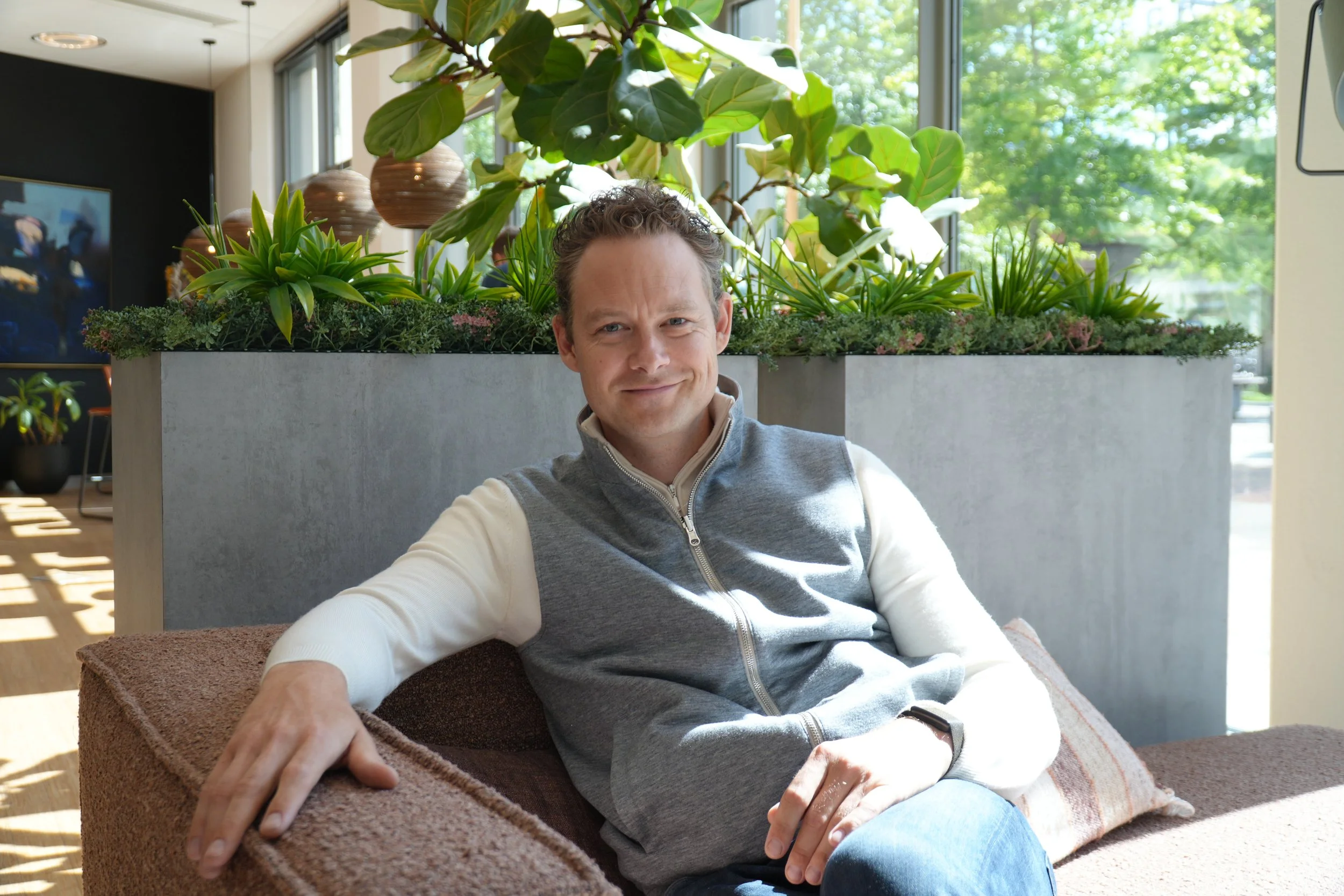
When we meet Dennis Theunis online, he's calling in from his role as Managing Director and Vice President at frog Netherlands, Capgemini Invent's design and innovation consultancy of roughly 100 designers, strategists, and technologists. The conversation quickly turns to the accelerated pace of disruption reshaping industries worldwide. "The solo-founder company that runs 1 billion in revenue is already being built today,” he notes. "They are out there, and it will happen, and it will happen really, really fast."
Dennis's perspective is rooted in leading design and innovation for global clients across financial services, high tech, manufacturing, and consumer products. His work centres on two recurring challenges: how to drive growth by capitalising on technological momentum, and how to ensure businesses remain relevant in a world where disruption is always around the corner. It is from this vantage point – pragmatic yet optimistic – that he reflects on how designers can navigate an increasingly complex, AI-driven landscape.
“The role of the designer is shifting more towards how to educate and engage the people we work with on the bigger opportunities and, importantly, how to make it real.”
The most immediate shift Dennis observes is the compression of time. What once took weeks now happens in days, or even hours. He recalls when qualitative analysis, pattern seeking, and insight generation required large teams over periods of 16 weeks. While the core practices of research – understanding customer pain points, finding market signals, exploring opportunities – remain essential, the delivery mechanism has fundamentally changed. "The role of the designer is shifting more towards how to educate and engage the people we work with on the bigger opportunities and, importantly, how to make it real," he explains. "It's all about making an impact, shipping it as quickly as possible into the hands of users to learn about it and iterate quicker to find new insights."
This acceleration brings both challenges and opportunities. For some, the rapid automation of tasks might feel threatening. For others, particularly the highly talented designers Dennis works with at frog, it is liberating. He envisions a "supercharged designer" – individuals who leverage AI to accelerate their work but bring an irreplaceable layer of creativity and authenticity. In an environment where all competitors have access to the same large language models, differentiation becomes paramount. The really good designers, he argues, will be those who harness AI to stretch their thinking while still cultivating environments for authentic, human-centred creativity – the differentiator is taste, and taste is not something a large language model trains itself to have. This means physical collaboration with clients, deeper tech understanding, and storytelling that connects design choices to business outcomes. "If you understand the technology," he says, "it will also fuel your creative thinking."
“Designers have to make a step in understanding and explaining risk and business potential to the C-suite. For too long, design relied on C-suite curiosity to bridge the gap. That curiosity is running out.”
For design to truly thrive in this new landscape, Dennis insists, its leaders must become fluent in the language of business impact. "Designers have to make a step in understanding and explaining risk and business potential to the C-suite," he states. "For too long, design relied on C-suite curiosity to bridge the gap. That curiosity is running out." The opportunity lies in understanding economic models and how businesses create value beyond just money; speaking the language of growth, relevancy, and resilience against disruption. This foundational business literacy is what will allow designers to reclaim their position at the strategic level.
The increasing sophistication of in-house design teams and the accessibility of AI tools mean that the traditional agency model is also undergoing a profound transformation. With AI, the barrier to entry for building basic design capabilities is significantly lowered; internal teams or freelancers can easily handle transactional design work. "Transactional design work - a research sprint here, a UI assessment there - is not a viable business model for a firm like frog,” he asserts. Instead, leading consultancies must accelerate their focus on building intellectual property and developing proprietary services that clients are willing to pay for as part of larger transformations. He cites frog's investment in "synthetic strategy" – using AI for future-casting and scenario planning – as an example of how agencies can productise their craft. This move from advice to proprietary product is not optional, it's the only defensible position.
“The change we have seen in the last 10 years may now happen in two or three – that’s how fast the craft of design is being reinvented.”
The challenge for individual designers, especially those who have practised for decades, is to embrace a growth mindset and be willing to shed old habits. "Designers need to fight hard to keep their inherent provocative and unconventional thinking,” Dennis stresses. “This often leads to friction with other business leaders, but that friction is not a bug, it is a signal that design is doing its job." Yet some adaptation is required and the window for change is narrowing. "The change we have seen in the last 10 years may now happen in two or three – that's how fast the craft of design is being reinvented."
“There is an absolute need across the industry for the craft of design to prevent that we’re going to live in a world with vanilla experiences where nobody stands out.”
Despite these pressures, Dennis remains defiantly optimistic about the enduring value of specialised design. "There is an absolute need across the industry for the craft of design to prevent that we're going to live in a world with vanilla experiences where nobody stands out," he states. AI, by its nature, tends towards the average, the predictable, the vanilla. It is the human designer who brings the authentic, empathetic, and innovative experiences that truly differentiate. By fully embracing new technology, designers can achieve an immense scalability of their craft, bringing their unique signature into products and services that touch millions globally. "We are all trying to find new meaning in the craft," he reflects, "which is sometimes a bit scary, maybe, but I'm also optimistic." For Dennis, this era is not a crisis for design but a profound opportunity – one that demands new fluencies, new courage, and the willingness to let go of what once worked in order to discover what comes next.
Dennis Theunis leads frog Netherlands, Capgemini Invent's design and innovation consultancy of roughly 100 designers, strategists, and technologists. He works where design craft meets applied AI — using AI to sharpen design judgement rather than replace it, so teams spend more time on the human and strategic problems only they can solve. Dennis believes design earns its seat in the boardroom by proving its value in the language executives already speak — growth, risk, and margin — without losing the curiosity, craft, and human insight that make it design in the first place.
